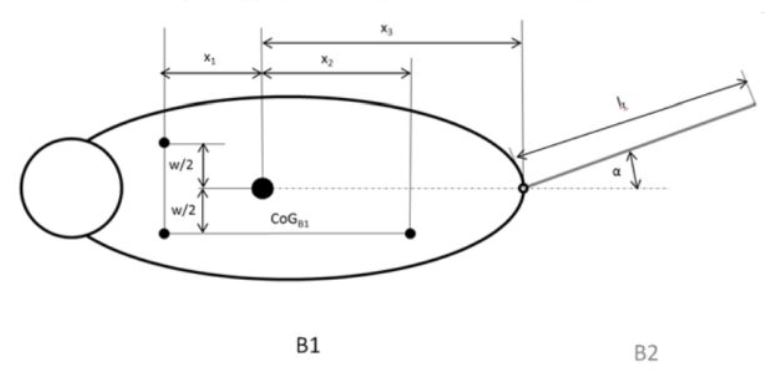
The car of an FSA technical inspector stays away from balconies but has lost a leg in a terrible racing accident. The simplified mechanical model of the cat consists of a solid body (B_1) that represents the head, torso and legs. The body B_1 has the mass m and the dimensions that can be taken from the sketch (top view of the cat). The 3 legs are assumed to be vertical bars. The cat's tail is modeled as a beam B_2 with the line load q. This is connected at the height of the center of gravity with B_1 and can be privoted in the horizontal plane. x_1 in mm: 100 x_2 in mm: 250 x_3 in mm: 275 w in mm: 125 I_t in mm: 400 m in kg: 2 q in kg/m: 0.5 alpha in deg: 30 The cat moves its tail by the angle alpha to the right. Which of the following statements is true?
AI image description
Top-view mechanical sketch of a cat model: a circle on the left represents the head, a large elongated oval body is labelled B1, and a straight narrow tail labelled B2 extends diagonally up and to the right from a pivot at the rear/right tip. Three small black points mark leg/support positions on the body, two towards the front (vertically separated by w, shown as w/2 above and below the dotted centerline) and one towards the rear on the lower side. A large black dot inside the body is labelled CoG_B1. Horizontal dimension arrows mark x1 (front support line to CoG), x2 (CoG to rear support), and x3 (CoG to tail pivot); the tail length is marked l_t and its angle above the horizontal as α.
- The cat is in an unstable equilibrium.
- The cat loses stability and falls over to the left.
- The cat loses stability and falls over to the right.
- The cat is in a syable equilibrium.Correct
Official answer
The cat is in a syable equilibrium.
Departments
Not tagged yet.
Occurrences
- FSA 2021 · ev · quiz 14
- FSA 2021 · cv · quiz 15