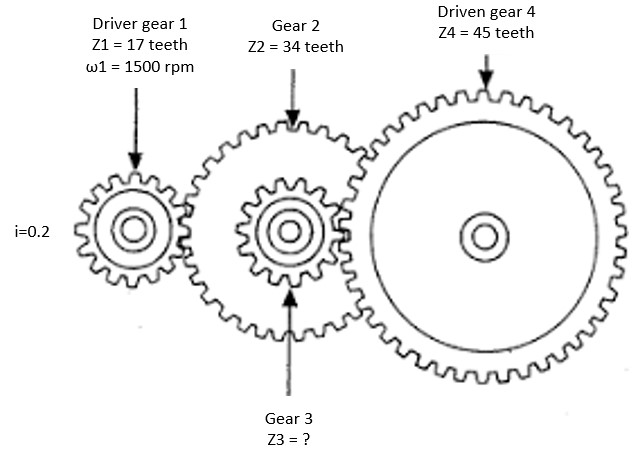
Consider the gear train shown in the figure, where: ω1= 1500 rpm (driver gear), ω2=ω3 (compound gear), z1=17 teeth, Z2=34 teeth and z4= 45 teeth. If the transmission ratio (i=ωdriven/ωdriver) is i=0.2, how many teeth should gear 3 have? Note: The image does not correspond exactly to the data.
AI image description
Schematic of a four-gear compound train. At left, small driver gear 1 is labeled Z1 = 17 teeth and ω1 = 1500 rpm. It meshes with larger gear 2, labeled Z2 = 34 teeth, on the central shaft. A smaller gear 3 on that same central shaft is labeled Z3 = ? and meshes with large driven gear 4 on the right, labeled Z4 = 45 teeth. The diagram also states i = 0.2. The arrowed labels distinguish gear 2 (upper central wheel) and gear 3 (lower/smaller central wheel).
- Z3 = 450 teeth
- Z3 = 64 teeth
- Z3 = 18 teethCorrect
- In simple gear trains, gears between the input and output gears do not change the speed ratio. Z3 can be any value.
Official answer
Z3 = 18 teeth
Departments
Not tagged yet.
Occurrences
- FSS 2020 · ev · quiz 17